

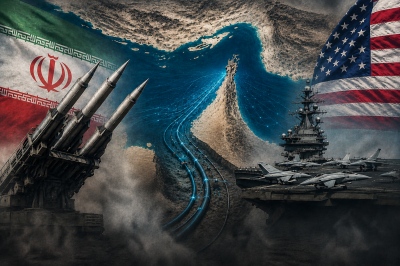
The diplomatic stalemate persists, leaving the US and Iran with their fingers on the trigger, prepared for open warfare to erupt at any moment. However, Tehran holds the ultimate strategic card—a "superweapon" capability requiring not a single bullet to sow absolute panic across Washington, its regional allies, and the global financial architecture.
Absolute dominance and panic
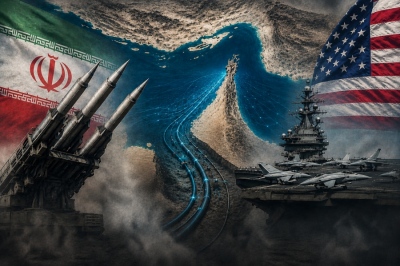
The Japanese newspaper Times has revealed that Iran can impose total dominance over the subsea infrastructure of the Strait of Hormuz without launching a single conventional military operation. The Times reported that Iran can exert significant structural control over the region's undersea internet cables simply by obstructing essential maintenance and repair operations beneath the Strait of Hormuz rather than targeting them with kinetic strikes.
The report highlights that among the critical international communication networks traversing the Strait of Hormuz is a vital branch of the Asia-Africa-Europe-1 (AAE-1) cable system, which connects global hubs from Hong Kong all the way to Italy and France. The massive streams of data routed through these subsea lines encompass high-definition video, global emails, social media networks, critical financial transactions, and classified government communications.
Furthermore, defense analysts point out that Iran maintains the capability to either launch direct attacks on the physical lines or effectively block marine infrastructure firms from deploying vessels for routine maintenance, emergency repairs, or the installation of newer fiber-optic networks. Under these operational conditions, it is emphasized that US military assets have been entirely unable to deter Iranian maritime operations conducted from the country's extensive Persian Gulf coastline, leaving Tehran in possession of formidable leverage.
Al Jazeera reports indirect negotiations continue
The US and Iran are sustaining their indirect diplomatic tracks through the mediation of Pakistan, the Al Jazeera television network reported, citing high-level Iranian media disclosures. "At this moment, the two adversaries are actively exchanging official messages and draft treaty frameworks in a synchronized effort to establish a formal baseline for a binding agreement," Al Jazeera asserts.
This diplomatic movement follows Tehran's submission of a revised comprehensive proposal to Washington earlier this week. According to Iranian diplomatic descriptions, the text largely reiterates core sovereignty terms that President Trump had previously rejected, including absolute Iranian oversight of the Strait of Hormuz, structural war reparations, sweeping sanctions relief, the immediate unfreezing of overseas state assets, and the total withdrawal of American military forces from the theater.
US and Iran edge closer, but profound structural chasm remains
In the high-stakes arena of active diplomacy, the US and Iran remain fundamentally deadlocked as both capitals dig in over two non-negotiable issues: Iran's domestic enriched uranium inventories and the ultimate operational jurisdiction of the Strait of Hormuz. US Secretary of State Marco Rubio stated that there have been "certain positive signs" observed during the proximity talks, even as President Trump publicly vowed that the US will ultimately seize and remove Iran's stockpiles of highly enriched material, which Washington insists are destined for a clandestine nuclear weapons program—a claim Tehran categorically denies.
'We will take it, we will destroy it'
"We are going to take it. We don't need it, we don't want it. We will probably destroy it once we secure it, but we are absolutely not going to allow them to keep it," Trump told reporters at the White House, referring directly to Iran's enriched uranium.
Absolute rejection of Hormuz transit tolls
Secretary Rubio clarified that a lasting diplomatic resolution would become mathematically impossible if Tehran proceeded with its unilateral plans to levy transit fees on international commercial shipping passing through the Strait of Hormuz. Nevertheless, the top US diplomat conceded that negotiators had notched incremental progress. "There are some positive signs," Rubio noted. "I don't want to be overly optimistic... Let's see what develops over the course of the coming days."
President Trump leveled fierce criticism at Tehran's stated intentions to impose maritime transit tariffs across the chokepoint. "We want it to remain completely open, we want it to be free. We will not tolerate tolls. This is an international waterway," Trump warned, asserting that he stands fully prepared to authorize a renewed bombing campaign against Iranian targets if the White House does not receive the "correct answers" from Iran's leadership.
Politico reveals nuclear enrichment and Hormuz transit remain the primary friction points between US and Israel
Regarding the volatile negotiations with Iran, a senior White House official claimed that the core pillars of disagreement remain narrowed down to two non-negotiable US demands:
-
The total non-possession of nuclear weapons
-
Maintaining unhindered navigation through the Strait of Hormuz Objective number one is that Iran can never possess a functional nuclear weapon. Objective number two is that the Strait of Hormuz must remain fully open, free of transit tolls, and insulated from Iranian maritime strikes, ensuring the unrestricted flow of international shipping throughout the region. While other secondary elements must be factored into a final accord, these two issues are definitively paramount.

Disagreements narrow but persist
A senior Iranian diplomatic source told Reuters that while a finalized agreement has not yet been clinched, the structural differences between the negotiating teams have narrowed. The official added, however, that Iran’s sovereign right to domestic uranium enrichment and Tehran’s de facto control over the Strait of Hormuz remain the insurmountable friction points preventing a breakthrough.
Two separate high-level Iranian officials disclosed to Reuters prior to Trump’s press conference that Iran’s Supreme Leader, Ayatollah Mojtaba Khamenei, has issued a strict binding directive forbidding any domestic uranium from being shipped outside the nation's borders—a sovereign position expected to further complicate Western efforts to engineer a diplomatic settlement.
Revolutionary Guard issues far-reaching threats
Iran’s Revolutionary Guard issued a stark public warning declaring that any potential renewal of US or Israeli airstrikes would trigger immediate retaliatory strikes extending far beyond the immediate Middle Eastern theater, targeting strategic assets in "locations that no Western planner can possibly conceive." Furthermore, the elite command asserted that the White House’s foundational assumptions of executing a quick and easy military campaign against Iran have been completely shattered by reality.
"The passage of time is not working in your favor. If the US wishes to extricate its forces from this multifaceted strategic dilemma, it must seriously reckon with Iran's defense initiative and asymmetric military threats," the Revolutionary Guard statement warned.
CENTCOM places US forces in Middle East on 'maximum readiness'
The American military states that its deployed combat assets across the Middle East remain positioned at maximum operational readiness. US Central Command (CENTCOM), which directs all front-line operations in the ongoing war posture against Iran, announced that the USS Abraham Lincoln carrier strike group is currently maintaining a "peak alert posture" within the waters of the Arabian Sea.
In an official social media broadcast, CENTCOM published imagery showcasing American carrier-based aviation assets, including advanced F-35 stealth fighters, launching from the flight deck, emphasizing that its forces stand ready to act while actively enforcing the strict US naval blockade surrounding Iranian commercial ports.
House Republicans abruptly cancel war powers resolution vote
Republican leaders in the House of Representatives abruptly pulled a high-profile war powers resolution from the floor on Thursday, May 21, just as the measure neared a final vote. The sudden cancellation occurred as GOP whips realized they were on the verge of losing the vote due to unexpected member absences.
Congressional Democrats have repeatedly forced floor votes in both the House and Senate aimed at legally curbing Trump’s unilateral authority to wage war against Iran—a legislative campaign that in recent weeks has begun drawing steady, bipartisan support from anti-war Republicans. The resolution had been formally introduced by New York Democratic Representative Gregory Meeks, the ranking member of the House Foreign Affairs Committee.
The House Democratic leadership fiercely condemned the GOP decision to abort the vote, stating in a joint press release that "the Republican-controlled House continues to operate as a wholly-owned subsidiary of the Trump administration."
"House Republicans cowardly withdrew a scheduled vote on a War Powers Resolution—legislation that was on track to pass with robust bipartisan support and would have legally compelled the President to end the Middle East conflict," House Democratic Leader Hakeem Jeffries, Whip Katherine Clark, and Caucus Chairman Pete Aguilar said in the joint statement.
US Intelligence bombshell: Iran is rapidly reconstructing its military forces
The latest classified assessment circulated by US intelligence agencies delivered an unexpected shock to President Trump's military planners. The data reveals that Iran is rapidly reconstructing its core military capabilities, successfully replacing destroyed missile bases and mobile launchers while restarting the production lines of vital weapon systems under the umbrella of the six-month ceasefire.
American intelligence monitoring indicates that the Iranian military is regrouping at a tempo that far outpaces initial Western technical estimates. Tehran has already successfully reactivated a significant portion of its domestic unmanned aerial vehicle manufacturing infrastructure and is projected to fully restore its pre-war long-range drone strike capacities in just six months.
"The Iranians have shattered every single timeline established by the intelligence community regarding military reconstitution," an anonymous US official told CNN. The network further reported that the Iranians "have demonstrated an ability to effectively mitigate the long-term impacts of warfare by rapidly regrouping their forces in the wake of these intense kinetic campaigns." Earlier, US intelligence disclosures similarly revealed that Iran had successfully restored operational access to the vast majority of its missile silos, launch pads, and underground complexes, as reported by the New York Times.
These classified evaluations directly contradict public claims made by President Trump, who had asserted that Iran's missile forces were completely "decimated" by allied strikes. Instead, the Times reported that Iran has restored full operational access to 30 out of its 33 missile installations running along the Strait of Hormuz, enabling its coastal defense units to target American warships attempting to transit the strategic waterway.
A classified intelligence assessment cited by the Times reportedly concluded that Iran still retains approximately 70% of its mobile missile launchers and has successfully preserved roughly 70% of its pre-war missile inventory. Furthermore, satellite reconnaissance and advanced electronic surveillance assets indicate that Iran has re-established access to roughly 90% of its underground storage faciliti es, which are currently rated as either partially or fully operational.
Axios and Washington Post report Netanyahu is actively sabotaging peace as US drains 50% of its THAAD missile inventory
According to investigative reporting by Axios, the primary structural barrier preventing a diplomatic settlement between the US and Iran is the fierce opposition of Israeli Prime Minister Benjamin Netanyahu to any negotiated framework. Netanyahu remains committed to extending the military campaign to achieve the total defeat of Iran, whereas Trump favors a negotiated resolution. Meanwhile, the Washington Post reported that the United States expended a massive portion of its strategic missile interceptor inventory to shield the Israeli regime during recent joint engagements against Iran, leading to a critical drawdown of America's advanced defensive stockpiles. The US military has fired over 200 THAAD interceptor missiles to defend Israel, a figure that represents nearly half of the Pentagon's total active stockpile for this advanced defense system.
War crime allegations: Iran fires back at US and Israel over bombing of Pasteur Institute
Tehran has formally leveled war crime allegations against the allied coalition, fiercely condemning the joint US-Israeli air assault that targeted the historic Pasteur Institute. The spokesman for the Iranian Ministry of Foreign Affairs, Esmaeil Baghaei, denounced the March strike against the complex, which belongs to a prestigious global network of research hubs dedicated to medical science and pathology.
In a public statement broadcast on X, Baghaei declared: "The deliberate US-Israeli strike on Iran's Pasteur Institute constitutes a flagrant war crime. The perpetrators behind this scientific sabotage must be held internationally accountable."
Baghaei noted that the targeting of a century-old scientific and humanitarian institution represents a direct assault on the fundamental rights of the Iranian civilian population to health, medical advancement, and life. His statements came as a direct response to an editorial published by The Lancet, one of the world's premier medical journals, which warned that the physical destruction of the institute presents a grave crisis for the broader region's health security.
According to The Lancet report, the World Health Organization has officially verified that the facility is completely non-operational and unable to deliver vital pathology services following the recent bombardment. The strikes follow years of stringent international sanctions that had already left Iran’s public health network in a highly vulnerable state. Meanwhile, the Iranian Red Crescent Society (IRCS) has published its first compilation of field footage showcasing its rescue teams and volunteers extracting 7,200 injured civilians from the rubble of dense urban zones targeted by US and Israeli air campaigns prior to the implementation of the current truce.
www.bankingnews.gr







Σχόλια αναγνωστών